German Shepherds are one of the most intelligent and capable dog breeds in the world. Because of this, many owners worry they are not doing enough to keep their dog mentally engaged. Others go in the opposite direction and overload their German Shepherd with constant training, games, and tasks — only to end up with a restless, anxious dog.
Mental stimulation is not about doing more — it is about creating clear, structured engagement that allows the dog to think and then truly relax.
The truth is that mental stimulation is not about doing as much as possible. It is about doing the right amount, in the right way, at the right time.
In this article, we’ll explain how much mental stimulation a German Shepherd really needs each day, what counts as healthy mental work, how to tell when your dog needs more — or less — and how mental overload can quietly create behavioral problems. For a broader overview of how mental work, anxiety, routine, and overstimulation connect, see the complete German Shepherd behavior guide.
Why Mental Stimulation Matters So Much for German Shepherds
German Shepherds were bred to think, observe, and make decisions. Their intelligence is not a bonus feature — it is a core trait of the breed.
When that intelligence is not given a clear outlet, it does not simply disappear. Instead, it often turns into:
- Restlessness
- Whining during downtime
- Overreacting to the environment
- Difficulty relaxing
- Ignoring commands outside familiar settings
Many of these behaviors are discussed in guides focused on chronic anxiety and nervous overload in German Shepherds, where lack of proper mental balance is a recurring theme.
What Counts as Mental Stimulation?
Mental stimulation is often misunderstood as “doing tricks” or “constant training.” In reality, mental work includes any activity that requires the dog to focus, think, decide, or solve a problem.
- Short, structured training sessions
- Scent work and search games
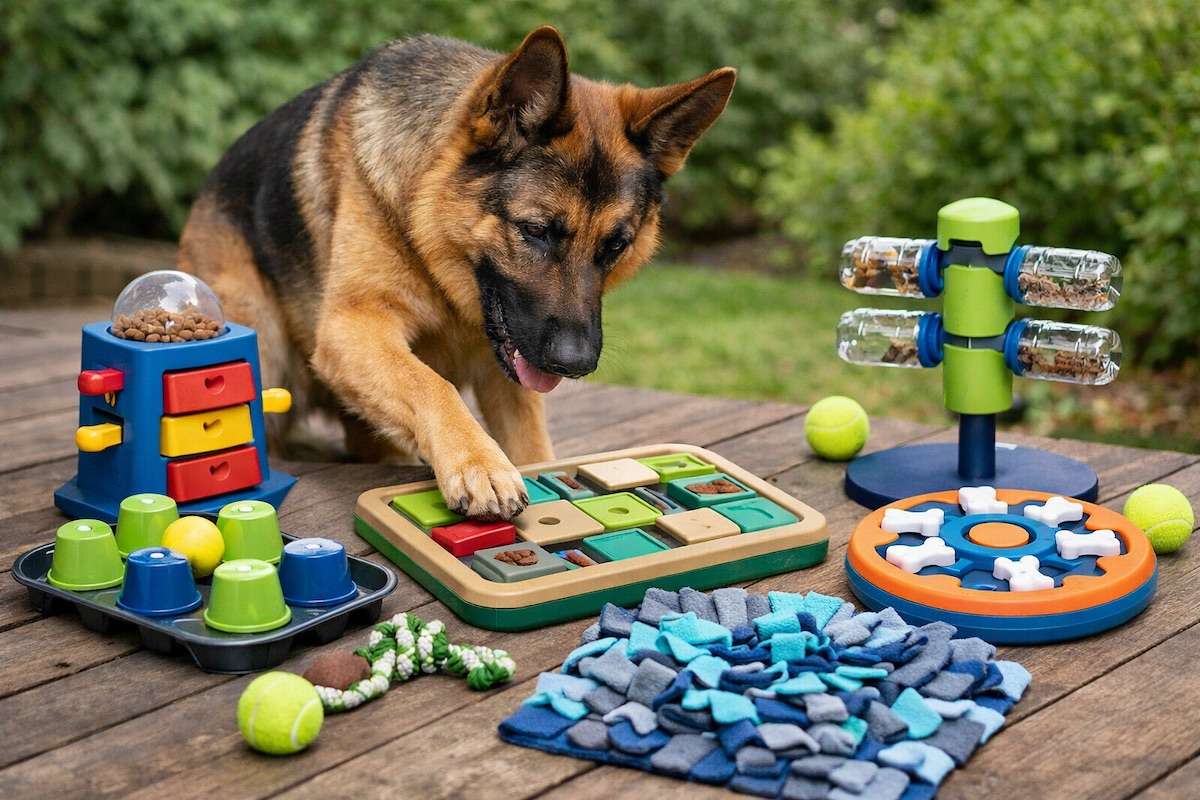
- Food puzzles and enrichment toys
- Learning new routines or skills
- Calm problem-solving tasks
One of the most common mistakes owners make is turning every interaction into training. Constant mental pressure can create nervous tension instead of improving focus.
Importantly, mental stimulation should not always be exciting. The goal is engagement, not constant arousal.
How Much Mental Stimulation Does a German Shepherd Need Daily?
For most adult German Shepherds, the ideal amount of mental stimulation is:
- 30–60 minutes per day, split into short sessions
- Delivered in 5–15 minute blocks
- Balanced with real rest afterward
Instead of one long training session, try two or three short focus exercises spread throughout the day. Many German Shepherds become calmer when mental work is predictable and limited.
This does not mean one long hour of training. In fact, that approach often backfires.
A typical healthy day might include:
- One short training session in the morning
- A mental game or puzzle after a walk
- A brief focus exercise in the evening
When mental work is spread throughout the day, it helps regulate the nervous system instead of overwhelming it.
Why More Mental Stimulation Is Not Always Better
One of the most common mistakes owners make is assuming that if some mental stimulation is good, more must be better.
Increasing mental tasks when your dog already struggles to relax can push them into chronic overstimulation — a state that often looks like “too much energy.”
In reality, excessive mental work can push a German Shepherd into the same overstimulated state as too much physical exercise.
- Difficulty settling after training
- Whining during rest periods
- Increased reactivity
- Loss of focus rather than improvement
- Appearing “tired but wired”
This pattern is explained in more detail in comparisons between overstimulation and lack of exercise.
Mental Stimulation vs Physical Exercise
Mental stimulation and physical exercise are not interchangeable — they serve different purposes.
| Type | Main Purpose | Effect on Behavior |
|---|---|---|
| Mental stimulation | Focus and decision-making | Calms internal tension |
| Physical exercise | Energy release | Improves overall balance |
| Overuse of either | Nervous overload | Increased anxiety and reactivity |
Balanced dogs are not constantly busy. They experience clear cycles of engagement, recovery, and rest throughout the day.
How Mental Stimulation Fits Into a Daily Routine
Mental work should be part of a predictable daily rhythm, not random bursts of activity.
German Shepherds thrive when mental tasks are built into a structured daily routine with clear activity and rest periods.
Signs Your German Shepherd Needs More Mental Stimulation
- Boredom-related behaviors
- Seeking constant interaction
- Improved behavior after focused tasks
- Destructive behavior despite adequate exercise
If your dog becomes calmer after short thinking exercises rather than intense play, mental engagement may be more important than additional physical activity.
Signs Your German Shepherd Needs Less Mental Stimulation
- Whining after training sessions
- Difficulty settling during rest time
- Declining focus during exercises
- Heightened anxiety or reactivity
These signals often overlap with behaviors discussed in articles focused on stress-related vocalization.
Simple Mental Stimulation Ideas That Actually Help
- Scent searches using hidden treats
- Short obedience refreshers
- Food puzzles used calmly
- Learning new but simple skills
Mental stimulation works best when it ends before your dog loses focus. Stopping early builds confidence and prevents overload.
When Mental Stimulation Fails to Help
If mental work does not improve behavior, consider whether the issue is actually stress, anxiety, or environmental pressure.
Many owners notice that mental stimulation alone does not fix problems like ignoring commands in public. In those cases, environmental overload can override learned behavior.
Final Thoughts
Most German Shepherds do best with short, structured mental work followed by real downtime. Balance — not intensity — creates calm, focused behavior.
German Shepherds do not need constant mental stimulation — they need appropriate, structured, and limited mental work.
The goal is not to keep your German Shepherd busy all day. The goal is to help them think clearly, then rest peacefully.
Author: XPETSI Editorial Team