German Shepherds are intelligent, loyal, and deeply connected to their owners. But for many people living with this breed, daily life comes with a constant concern: anxiety. Restlessness, pacing, whining, overreacting to sounds, or an inability to relax are not rare problems — and they can slowly exhaust both the dog and the owner.
For many German Shepherds, anxiety isn’t “fear” — it’s the nervous system staying switched on because the day feels unclear, unpredictable, or overstimulating.
For a broader overview of anxiety patterns, overstimulation, and daily structure in this breed, see the complete German Shepherd behavior guide, which explains how these patterns connect across everyday situations.
If your German Shepherd seems anxious most of the day, this is rarely a random personality trait. In the majority of cases, anxiety develops as a response to routine imbalance, chronic overstimulation, unclear expectations, or unmet mental needs. Understanding where that anxiety comes from is the first step toward reducing it.
This article explains why German Shepherds are especially prone to anxiety, how to recognize different anxiety patterns, what causes owners often overlook, and what actually helps calm an anxious German Shepherd in real life.
Are German Shepherds Naturally Anxious Dogs?
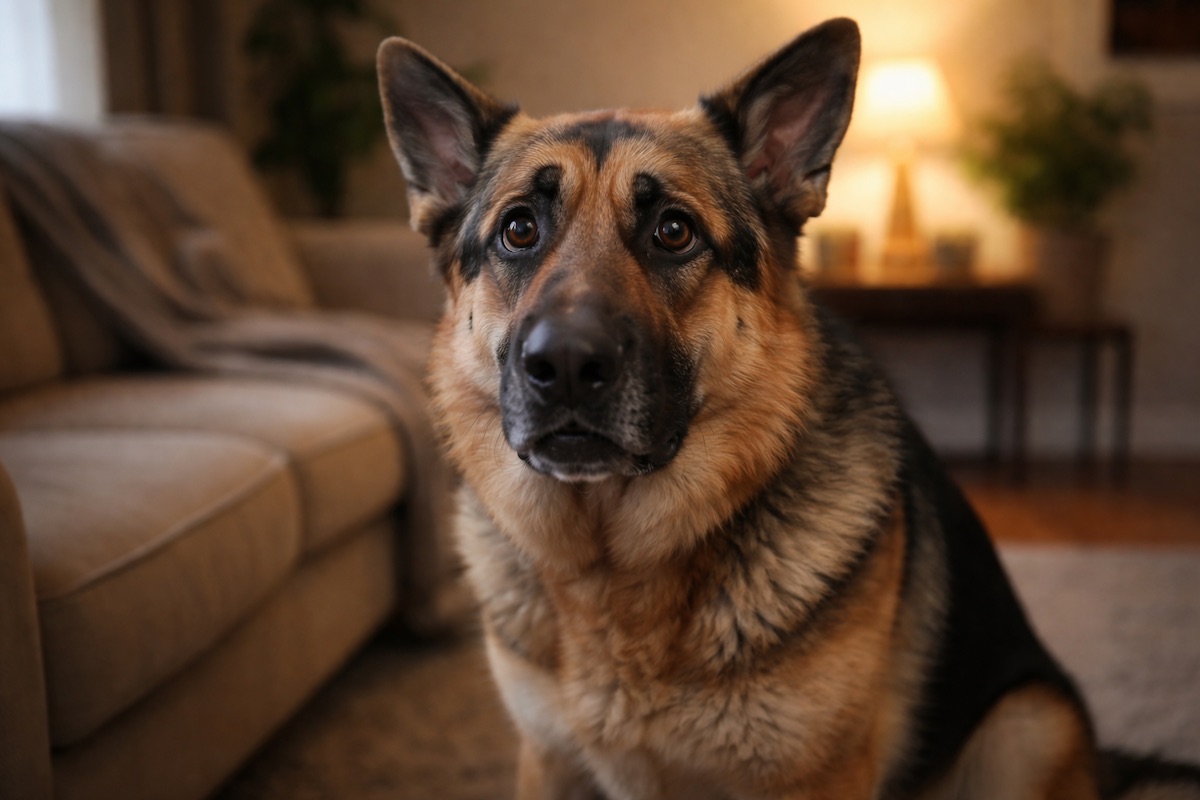
German Shepherds are not born anxious, but they are naturally highly alert and sensitive. This breed was developed to constantly monitor its surroundings, respond quickly to changes, and work closely with humans. These traits are extremely valuable in working contexts, but they also mean the dog is more affected by chaos and inconsistency.
Compared to more easygoing breeds, German Shepherds tend to react faster to environmental changes, emotional tension in the household, and unpredictable routines. When daily life lacks structure, their alertness has nowhere to go — and it often turns inward as anxiety.
A German Shepherd that “can’t relax” is often carrying too much responsibility without clear guidance: too many triggers, too few predictable patterns, and not enough true recovery.
What Anxiety Looks Like in German Shepherds
Anxiety does not always appear as panic or visible fear. In German Shepherds, it often presents as constant tension and inability to fully relax.
Common anxiety-related behaviors include:
- Pacing around the house without settling
- Whining, sighing, or vocalizing without an obvious trigger
- Following the owner from room to room
- Overreacting to normal household sounds
- Difficulty focusing during walks
- Ignoring commands in stimulating environments
If vocalization is a frequent issue, it is often connected to internal stress rather than disobedience. Many owners notice improvement after understanding why whining can become a stress habit.
Quick self-check: if your dog paces, scans, or vocalizes most during “quiet time,” the issue is often not lack of exercise — it’s an inability to switch off.
Why German Shepherd Anxiety Develops Over Time
1. Unpredictable Daily Structure
German Shepherds rely heavily on predictability. When feeding times, walks, training, and rest happen randomly, the dog never fully switches off. Instead of relaxing, it stays alert, waiting for the next change.
If your dog seems anxious “all day,” don’t start by adding more activity. First look at structure. A chaotic schedule often creates anxiety even in dogs with plenty of exercise.
Over time, this constant anticipation creates nervous behavior. Many owners notice a significant improvement once the dog’s day follows a consistent rhythm. This is why a predictable routine can stabilize behavior.
2. Overstimulation Mistaken for High Energy
One of the most common mistakes is assuming that anxiety means the dog needs more exercise. In reality, many anxious German Shepherds are already overstimulated.
Signs of overstimulation include difficulty calming down after activity, exaggerated reactions during walks, constant scanning of the environment, and restlessness even after long exercise sessions.
More intensity is not always the fix. If your German Shepherd is “tired but wired,” adding more running or fetch often trains the nervous system to stay aroused.
In these cases, the missing piece is usually calm recovery — not more movement.
3. Lack of Mental Engagement
German Shepherds need more than physical movement. Without mental challenges, their intelligence turns into internal pressure.
Mental engagement does not mean constant training drills. It means giving the dog opportunities to think, solve problems, and focus calmly. Even short daily mental tasks can significantly reduce anxiety levels.
Dogs that lack mental stimulation often appear hyper or nervous, but the root problem is boredom combined with alertness.
If your dog struggles to settle after exercise, try adding a short calm thinking task instead of more physical intensity — scent searching, a simple focus routine, or a food puzzle used quietly.
4. Emotional Feedback From the Owner
German Shepherds are extremely sensitive to human emotions. Stress, frustration, or inconsistency in the owner’s behavior often transfers directly to the dog.
When the owner feels overwhelmed, the dog may attempt to take control of the environment by staying hyper-alert. This behavior looks like anxiety, but it is often the dog trying to compensate for uncertainty.
Your dog doesn’t need you to be perfect. They need you to be predictable. Calm, consistent handling often reduces anxiety faster than “more training.”
5. Insufficient Rest and Recovery
Many anxious German Shepherds simply do not rest enough. Constant interaction, noise, or stimulation prevents proper recovery.
An adult German Shepherd typically needs long, uninterrupted periods of rest throughout the day. Without this, the nervous system never fully resets, and anxiety slowly becomes the default state.
If your dog is always “on,” check whether they actually have permission to switch off. Many anxious German Shepherds are missing real downtime, not missing exercise.
6. Inconsistent Rules and Training Boundaries
When rules change from day to day, German Shepherds become unsure of what is expected. This uncertainty creates internal conflict.
Owners often notice this during walks, where the dog suddenly ignores commands it knows perfectly well at home. In many cases, this behavior is explained by environmental pressure overwhelming learned behavior, not stubbornness.
Separation Anxiety or General Anxiety?
Not all anxiety in German Shepherds is separation anxiety. Distinguishing between the two is essential.
| Behavior | Most Likely Explanation |
|---|---|
| Follows owner constantly | Insecurity or lack of independence |
| Distress only when alone | Separation anxiety |
| Always alert, even with owner present | General anxiety or overstimulation |
| Disobedience mainly outdoors | Environmental stress overload |
If your dog is tense even when you’re home, it’s often general anxiety or overstimulation — not separation anxiety.
Mislabeling general anxiety as separation anxiety often leads to ineffective solutions.
What Actually Helps an Anxious German Shepherd
Start with structure and recovery. Most German Shepherds improve when their day becomes predictable, their stimulation becomes calmer, and rest becomes real — not “rest while still on alert.”
Build a Predictable Routine
Consistency creates safety. Regular walk times, feeding schedules, and rest periods reduce uncertainty.
Balance Activity With Calm
Replace chaotic play with structured walks and controlled engagement.
Increase Mental Work
Daily problem-solving tasks help release internal tension.
Teach Calmness Explicitly
Reward calm behavior instead of constant excitement.
Stabilize Your Own Behavior
Clear, calm handling often reduces anxiety faster than any exercise plan.
When Professional Help Is Needed
If anxiety worsens, leads to aggression, or significantly impacts daily life, professional support is important.
Consider consulting:
- A trainer experienced with working breeds
- A veterinary behaviorist
- Your veterinarian to rule out medical causes
Final Thoughts
Anxiety fades when life becomes understandable to the dog: clear patterns, calm engagement, and enough recovery to let the nervous system reset.
Anxious behavior in German Shepherds is rarely random. It is usually the result of too much stimulation, too little structure, or unclear communication.
When daily life becomes predictable, mentally engaging, and calm, most German Shepherds show remarkable improvement. Anxiety fades not because the dog is forced to relax, but because life finally makes sense to them.
Instead of asking why your German Shepherd is anxious, it often helps to ask: does my dog clearly understand their role in the day?
Author: XPETSI Editorial Team