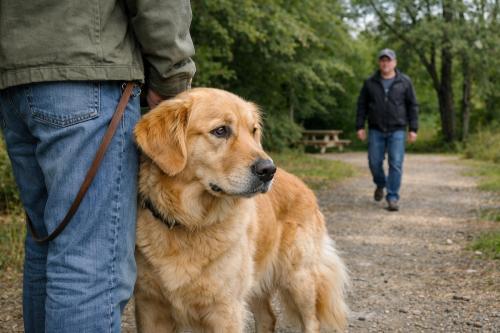
Golden Retrievers are highly social, intelligent dogs that enjoy learning, problem-solving, and participating in daily family life. Because of their enthusiasm and responsiveness, many owners worry about whether they are providing enough mental stimulation. Others go in the opposite direction and try to keep their dog constantly busy with training sessions, enrichment toys, and structured activities.
Mental stimulation is not about keeping a dog occupied all the time. It is about providing meaningful engagement that supports emotional balance, confidence, and the ability to relax afterward.
Understanding how much mental stimulation a Golden Retriever truly needs can help prevent both boredom-related behavior problems and nervous system overload. When cognitive engagement is balanced with recovery and predictable routines, many dogs become calmer, more focused, and easier to live with.
Why Mental Stimulation Matters for Golden Retrievers
Golden Retrievers were developed as cooperative working dogs that observe human behavior, make decisions, and remain responsive in changing environments. Their intelligence and sensitivity make them highly adaptable companions — but also mean they can become restless or emotionally unsettled when their cognitive needs are overlooked.
Healthy mental engagement supports:
- Emotional regulation and calmer reactions
- Improved focus during training and walks
- Reduced boredom-related behaviors
- Greater confidence in new situations
- Better balance between activity and rest
Without appropriate outlets for thinking and exploration, some Golden Retrievers may create their own stimulation through attention-seeking behaviors, scavenging, or excessive vocalization.
What Counts as Mental Stimulation?
Mental stimulation includes any activity that requires the dog to process information, make choices, or interact meaningfully with the environment. It does not always need to look like formal training.
Examples of healthy cognitive engagement include:
- Short training sessions focused on simple skills
- Scent games or controlled exploration during walks
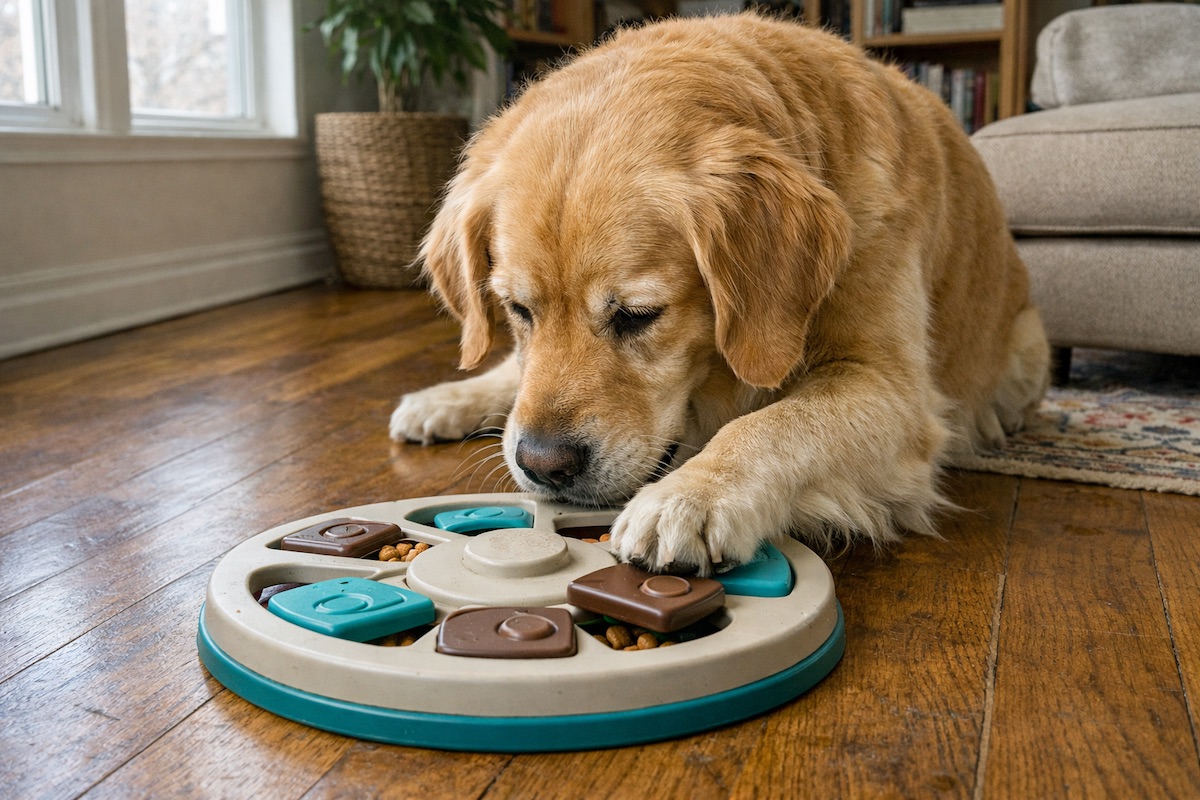
- Food puzzles or enrichment toys used calmly
- Learning predictable daily routines
- Problem-solving tasks such as finding hidden objects
Not all stimulation is beneficial. Activities that create constant excitement without recovery may increase nervous tension rather than improve behavior.
The goal is engagement that feels structured and manageable, not overwhelming or chaotic.
How Much Mental Stimulation Does a Golden Retriever Need?
For most adult Golden Retrievers, a balanced approach includes:
- 30–60 minutes of mental engagement per day
- Divided into short sessions of 5–15 minutes
- Combined with opportunities for calm rest and independent relaxation
This does not mean one long hour of intense training. Spreading cognitive activities throughout the day allows the nervous system to process experiences more comfortably.
A typical balanced day might include:
- A brief morning training refresher
- Sniffing and exploration during a walk
- A calm enrichment activity in the afternoon
- A short focus exercise in the evening
Many Golden Retrievers become calmer when mental work is predictable, limited in duration, and followed by genuine downtime.
Signs Your Golden Retriever May Need More Mental Stimulation
- Restlessness despite adequate physical exercise
- Seeking constant interaction or attention
- Destructive behavior during idle periods
- Improved behavior after short thinking activities
- Difficulty focusing during training due to accumulated frustration
These signals often indicate that cognitive needs are not being met in a structured way.
Signs Your Golden Retriever May Be Mentally Overstimulated
- Difficulty settling after training or play
- Whining or pacing during rest time
- Heightened sensitivity to environmental changes
- Declining performance despite increased effort
- Appearing tired but unable to relax
Too much mental pressure can create the same emotional tension as too little stimulation.
In these cases, reducing intensity and increasing recovery time often helps restore balance.
Mental Stimulation vs Physical Exercise
| Type of Activity | Main Purpose | Emotional Effect |
|---|---|---|
| Mental stimulation | Encourages thinking and decision-making | Builds confidence and focus |
| Physical exercise | Releases physical energy | Supports overall relaxation |
| Excessive stimulation | Creates cognitive overload | May increase anxiety and restlessness |
Both forms of activity are important, but they are not interchangeable. Balanced routines include movement, thinking, and recovery.
How to Provide Mental Stimulation in a Healthy Way
-
Keep sessions short and purposeful
Mental work is most effective when it is clear, structured, and limited in duration. Instead of long training marathons, focus on brief exercises that allow the dog to think and succeed without becoming mentally fatigued. Short sessions help maintain motivation, improve learning clarity, and prevent cognitive overload. Many Golden Retrievers respond better to several small thinking opportunities throughout the day than to one intense engagement period. -
End activities before the dog becomes frustrated or overly excited
Healthy stimulation builds confidence, while excessive pressure can lead to tension or impulsive behavior. Watch for early signs of mental fatigue such as declining focus, increased vocalization, or restless movement. Ending the activity while the dog is still engaged and calm teaches emotional regulation and helps preserve a positive association with learning. Stopping at the right moment often improves long-term responsiveness more than pushing for “just one more repetition.” -
Alternate engagement with calm downtime
Mental stimulation should be followed by genuine recovery. After training, scent games, or problem-solving tasks, allow the dog to relax without additional expectations. This balance helps the nervous system shift from active processing into restoration. Dogs that experience clear cycles of engagement and rest often become more emotionally stable, more focused during future sessions, and less likely to develop hyperactive or anxious behavior patterns. -
Use predictable routines to reduce anticipation
Golden Retrievers often feel more secure when they understand when mental work will occur and when it will end. Structured daily rhythms — such as short morning training, enrichment after walks, and calm evenings — reduce uncertainty and prevent constant mental monitoring. Predictability allows the dog to conserve emotional energy and improves their ability to disengage when stimulation is not required. -
Encourage independent relaxation between activities
Learning to rest without continuous interaction is an essential skill for intelligent dogs. Providing comfortable resting areas, limiting unnecessary interruptions, and calmly reinforcing self-chosen relaxation help the dog develop emotional resilience. Over time, this independence reduces the pressure to stay engaged at all times and supports a healthier relationship with both activity and stillness.
True enrichment supports emotional stability — not constant performance. Mental stimulation should help a dog feel clearer, calmer, and more confident, rather than perpetually busy.
When Mental Stimulation Alone Is Not Enough
If behavioral challenges continue despite appropriate cognitive engagement, other factors may be involved. Emotional sensitivity, environmental stress, inconsistent routines, or social dynamics can all influence how a Golden Retriever responds to daily life.
In such cases, focusing only on increasing stimulation may not resolve the underlying issue. Slowing down routines, improving predictability, and supporting deeper rest can sometimes have a greater impact.
Final Thoughts
Golden Retrievers thrive when their lives include meaningful thinking opportunities, emotional clarity, and real chances to relax.
Mental stimulation is an important part of caring for an intelligent, people-oriented breed. However, the goal is not to keep the dog busy at all times. Instead, balanced engagement helps create a confident companion who can participate actively — and rest peacefully — throughout the day.
Author: XPETSI Editorial Team