Many dog owners dream of having a highly intelligent companion — a dog that learns quickly, understands routines, and seems deeply connected to human life. Yet owners of intelligent breeds often notice something unexpected: when nothing is happening, their dog struggles the most. Instead of resting calmly, the dog becomes restless, follows every movement, scans the environment, or looks unable to simply “do nothing.”
For many highly intelligent dogs, idle time is not relaxing — it can feel confusing, uncomfortable, or even stressful.
This article explores why smart dogs often struggle during quiet moments, what idle time feels like from a nervous system perspective, how modern lifestyles unintentionally increase this difficulty, and what helps intelligent dogs learn how to truly rest without losing engagement or motivation.
What Is “Idle Time” for a Dog?
Idle time refers to periods when no clear task, interaction, or expectation is present. There is no walk, no training session, no play, and no direct communication — just ordinary daily life.
For many calm companion breeds, idle time naturally becomes recovery time. The dog rests, sleeps, or quietly observes the environment.
Highly intelligent dogs, however, often experience idle time differently. Instead of switching off automatically, their brains may remain active, searching for meaning or direction.
An intelligent dog without context may not interpret stillness as rest — but as uncertainty.
Why Intelligent Dogs Find Doing Nothing Difficult
1. Brains Built for Continuous Processing
Many intelligent breeds were developed for roles requiring constant awareness and decision-making: herding, guarding, problem-solving, or cooperative work with humans.
Their nervous systems evolved to:
- Monitor environmental changes
- Anticipate human actions
- Stay mentally prepared for tasks
- React quickly to subtle signals
When modern home life removes clear work structure, the brain does not automatically slow down. Instead, it continues scanning for purpose.
2. Anticipation Becomes the Default State
Highly intelligent dogs learn patterns quickly. If engagement frequently follows attention, the dog may begin expecting interaction at any moment.
This creates a state of ongoing anticipation:
- Watching the owner constantly
- Reacting to small movements
- Waiting for cues that never come
Idle time then feels incomplete rather than calming.
The dog is not seeking activity — they are seeking clarity.
3. Modern Life Removes Natural Endpoints
Working dogs historically experienced clear cycles:
- Work began
- Work ended
- Recovery followed
Modern households often blur these boundaries. Interaction appears randomly throughout the day, making it difficult for the dog to understand when engagement is finished.
How Idle Time Feels From the Dog’s Perspective
While humans interpret quiet moments as relaxation, intelligent dogs may experience them as:
- Unresolved expectation
- Incomplete task cycles
- Environmental monitoring responsibility
- Low-level cognitive tension
This internal state can produce behaviors owners misinterpret as boredom or excess energy.
Rest requires psychological safety — not just physical tiredness.
Common Signs a Dog Struggles With Idle Time
Dogs that struggle with idle time rarely look inactive or calm for long. Instead of resting naturally between activities, they remain mentally engaged even when nothing is happening. Because highly intelligent dogs are wired to observe and respond, quiet moments can feel confusing rather than relaxing. The following signs often indicate that a dog finds stillness uncomfortable rather than restorative.
-
Following the owner from room to room
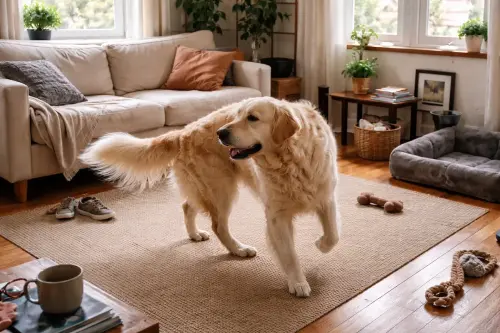
The dog moves constantly behind you, even when no interaction is occurring. This behavior is often mistaken for affection or loyalty, but it can also reflect uncertainty during downtime. Instead of feeling safe enough to disengage, the dog monitors your movements as if waiting for the next task or signal. True rest rarely happens because attention never fully turns off. -
Difficulty settling without commands
Some dogs only relax after being told to lie down or go to a specific place. While trained relaxation cues are helpful, reliance on commands for every calm moment suggests that independent rest feels unfamiliar. The dog may wait for structure because unstructured time creates mild internal tension or anticipation. -
Frequent repositioning instead of deep rest
A dog may lie down briefly, then stand up, circle, move to another spot, and repeat the cycle. This pattern shows that the body is tired but the nervous system remains active. Deep rest requires mental disengagement, and dogs struggling with idle time often cannot remain still long enough to enter true relaxation. -
Watching doors, windows, or movement constantly
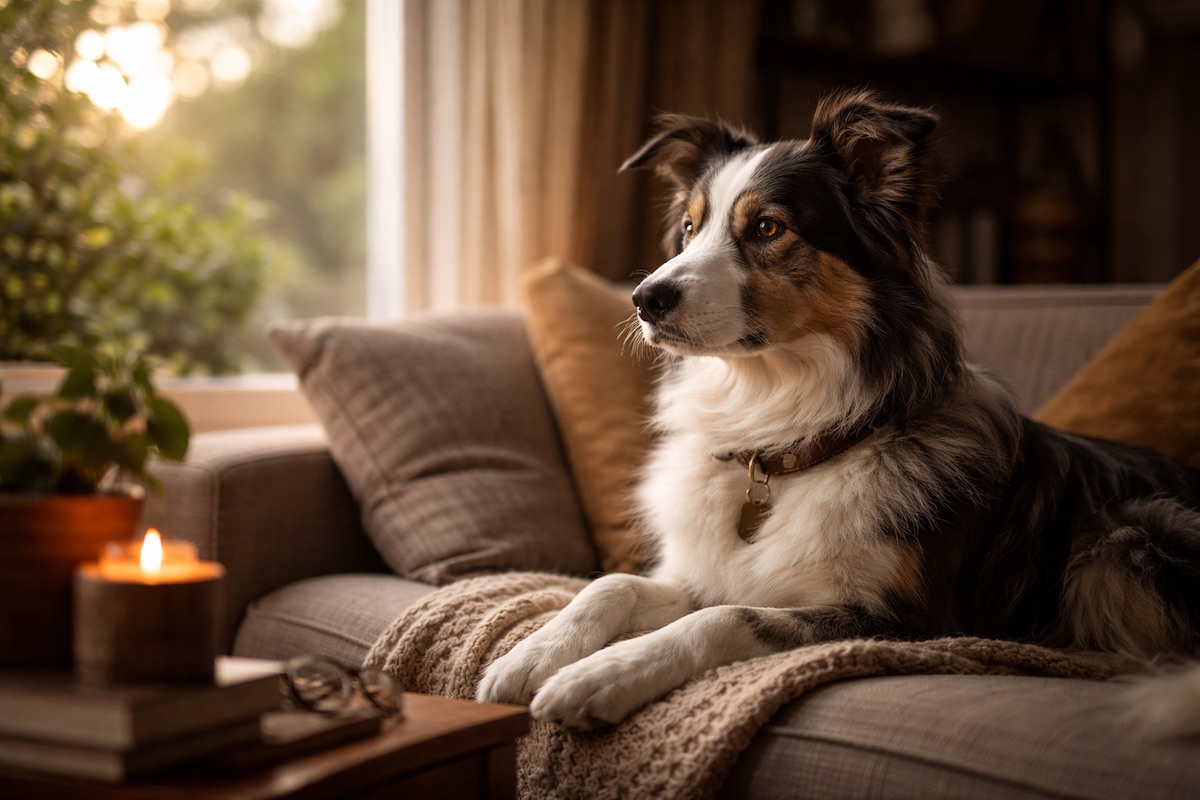
Highly observant dogs may scan the environment during quiet periods, tracking sounds, shadows, or subtle motion. While occasional alertness is normal, constant monitoring suggests the brain feels responsible for staying aware. Idle time becomes a period of vigilance rather than recovery. -
Whining or sighing during quiet periods
Soft vocalizations often appear when stimulation ends. These sounds are not always requests for attention; they can reflect internal frustration or difficulty transitioning from engagement to rest. The dog may seem unsure how to handle inactivity and expresses that discomfort through quiet vocal behavior. -
Appearing tired but unable to relax
One of the clearest signs is a dog that shows physical fatigue yet remains mentally alert. Eyes stay active, ears respond to every sound, and small movements quickly interrupt rest. Owners often describe this state as “tired but wired,” where exhaustion and alertness exist at the same time.
Interestingly, these behaviors often appear strongest after activity ends rather than during stimulation itself. While engagement provides structure and clarity, idle moments remove guidance — and for some intelligent dogs, that absence of direction creates subtle internal pressure. Learning to recognize these patterns helps owners understand that the issue is not excess energy, but difficulty switching from engagement into recovery.
Why More Activity Often Makes the Problem Worse
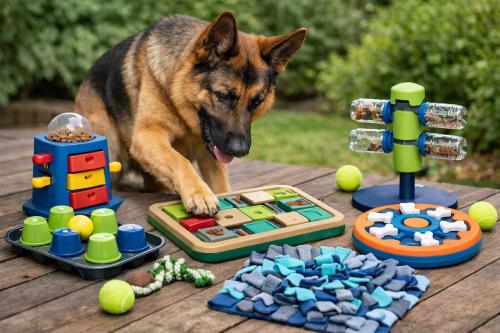
When dogs struggle during idle time, many owners respond by increasing exercise, training, or enrichment.
While well-intentioned, this can unintentionally reinforce the difficulty.
If stimulation always replaces discomfort, the dog never learns how to regulate calmness internally.
A dog that never practices resting cannot develop the skill of relaxation.
Over time, the nervous system may become dependent on constant engagement to feel stable.
The Difference Between Healthy Rest and Shutdown
| State | Healthy Rest | Stress or Shutdown |
|---|---|---|
| Body posture | Loose and relaxed | Still but tense |
| Breathing | Slow and regular | Shallow or alert |
| Awareness | Soft observation | Hyper-monitoring |
| Recovery | Wakes calmly | Startles easily |
True rest restores the nervous system. Shutdown or tension does not.
Why Intelligence Increases Sensitivity to Idle Time
Higher cognitive engagement often comes with increased emotional sensitivity. Intelligent dogs:
- Notice subtle environmental changes
- Read human emotional states closely
- Predict routines before they occur
- Stay mentally involved even without direction
Without structured recovery, awareness becomes continuous effort.
The same brain that learns quickly also tires quickly when it never fully switches off.
Teaching Intelligent Dogs How to Rest
Create Predictable Daily Rhythms
Consistency reduces anticipation. When activity happens at predictable times, idle periods feel safer and more understandable.
Build Clear End Signals
Simple rituals — slowing movement, putting away training tools, or guiding the dog to a resting space — help mark the transition from engagement to rest.
Reward Calm Choices
Notice when your dog relaxes independently. Quiet reinforcement teaches that calmness has value.
Allow Neutral Presence
Spend time together without interaction. Shared calm presence teaches the dog that connection does not always require action.
Reduce Background Pressure
Constant cues, corrections, or stimulation can maintain mental activation. Silence and predictability help the nervous system downshift.
Rest becomes easier when the dog understands that nothing is expected.
What Improvement Usually Looks Like
As dogs learn to tolerate and eventually enjoy idle time, owners often notice:
- Longer periods of deep rest
- Less shadowing behavior
- Softer body language indoors
- Faster recovery after walks or training
- More flexible attention overall
Importantly, motivation does not disappear. Engagement often becomes healthier because it is no longer driven by pressure.
Common Misconceptions About Intelligent Dogs
- “Smart dogs need constant stimulation.”
- “A tired dog is always a calm dog.”
- “Rest means boredom.”
In reality, intelligent dogs need balance between thinking and recovery — not endless activity.
Mental recovery is part of performance, not the opposite of it.
Final Thoughts
Highly intelligent dogs do not struggle with idle time because they are difficult or demanding. They struggle because their brains are designed to search for meaning, patterns, and interaction.
Learning to rest is not automatic for many smart dogs — it is a skill shaped by clarity, routine, and emotional safety.
When idle time becomes predictable and pressure disappears, many intelligent dogs discover something new: calmness is not the absence of connection, but a different form of it. And once that balance appears, both engagement and relaxation begin to feel natural again.
Author: XPETSI Editorial Team