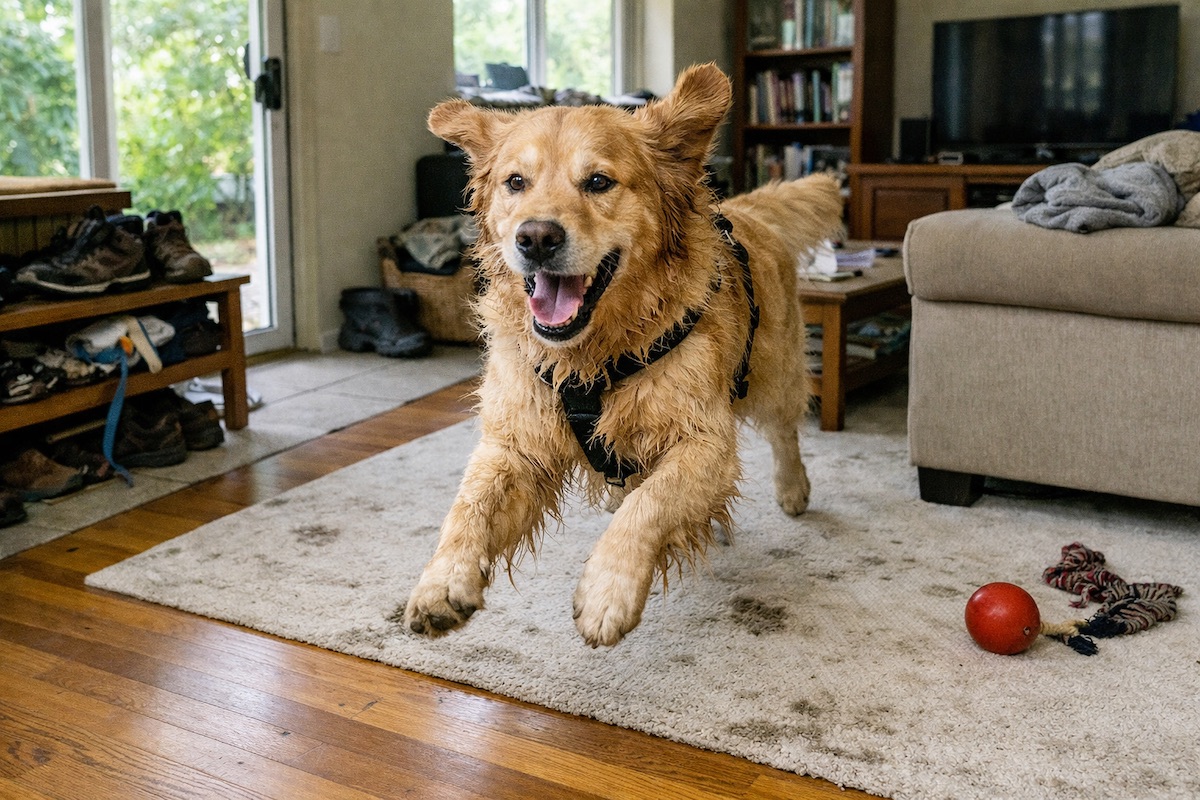
Many Golden Retriever owners expect their dog to relax after a walk — but instead, they come home to sudden bursts of energy. Running around the house, jumping on furniture, grabbing objects, or demanding attention can feel completely opposite to what you expected after exercise.
Post-walk hyperactivity is often not about “too much energy.” In many cases, it reflects overstimulation, emotional buildup, or difficulty transitioning from activity to rest.
Understanding why your Golden Retriever becomes wild after walks can help you adjust routines in a way that supports calmer behavior and better emotional balance.
Is It Normal for Dogs to Get Hyper After Walks?
Some short bursts of excitement after returning home can be normal, especially in younger dogs. However, when the behavior becomes intense, repetitive, or difficult to settle, it usually indicates that the dog’s nervous system has not fully processed the walk.
A walk does not always calm a dog. In some cases, it increases stimulation instead of releasing it.
Common Reasons Golden Retrievers Become Wild After Walks
Overstimulation During the Walk
Busy environments, constant movement, new smells, other dogs, and unpredictable events all require processing. Even if the dog appears excited and engaged, the nervous system may become overloaded.
When returning home, that accumulated stimulation can release as sudden bursts of activity.
Lack of Mental Processing Time
Walks that are fast-paced or highly structured leave little time for the dog to process sensory input. Without pauses for sniffing or observation, information builds up rather than being absorbed gradually.
Dogs need time to think, not just move.
Difficulty Transitioning to Rest
Some Golden Retrievers struggle to shift from active states into calmness. If there is no clear transition between “walk mode” and “home mode,” the dog may remain mentally activated.
Excessive Physical Arousal
High-energy activities such as intense play, fast walking, or constant stimulation can raise adrenaline levels. This can keep the dog excited even after the walk ends.
Emotional Excitement and Anticipation
Walks are highly rewarding experiences. For some dogs, the emotional excitement continues after returning home, especially if the transition is abrupt.
Insufficient Rest During the Day
If the dog has not had enough quality rest before the walk, the added stimulation can push them into an overtired state — often expressed as hyperactivity.
“Tired but wired” behavior is common when stimulation exceeds recovery.
Signs Post-Walk Hyperactivity Is Linked to Overload
- Running in bursts around the house
- Grabbing objects or chewing impulsively
- Difficulty lying down and staying calm
- Whining or barking without clear reason
- Appearing excited but unfocused
These behaviors often indicate that the nervous system is still in an activated state.
Healthy Energy Release vs Overstimulation
| Behavior | Healthy Response | Overstimulation |
|---|---|---|
| After walk | Gradual relaxation | Sudden hyperactivity |
| Body language | Loose and calm | Tense or frantic |
| Focus | Responsive | Distracted or impulsive |
| Recovery | Settles easily | Struggles to relax |
Understanding this difference helps prevent adding more stimulation when the dog actually needs recovery.
How to Help a Golden Retriever Calm Down After Walks
Slow the End of the Walk
Many walks end too abruptly — one moment the dog is actively moving, exploring, and processing the environment, and the next they are suddenly back inside. This sharp transition can leave the nervous system in an activated state.
Gradually reducing stimulation during the final minutes of the walk helps signal that the active phase is ending. Slow your pace, reduce interactions, and avoid exciting stimuli such as other dogs or fast movement. This creates a natural emotional “landing” instead of a sudden stop.
Create a Transition Routine
Consistent post-walk rituals help the dog understand what comes next. Removing the leash calmly, offering water, guiding the dog to a familiar resting area, or briefly sitting together all act as signals that the walk has ended.
Over time, these repeated patterns reduce uncertainty and make it easier for the dog to shift from activity into recovery. Predictable transitions are especially important for sensitive or highly engaged dogs.
Allow Calm Decompression
After returning home, many dogs need time to process everything they experienced. Avoid immediately engaging in play, training, or high-energy interaction. Even positive excitement can prolong activation.
Instead, create a quiet environment where the dog can settle naturally. Some dogs may lie down, others may calmly walk around before relaxing — both are part of the decompression process.
Include Sniffing During Walks
Sniffing is one of the most effective natural regulators of a dog’s nervous system. Walks that include time for scent exploration are often less overwhelming because the dog processes information gradually rather than accumulating it.
Allowing controlled sniffing moments helps reduce post-walk hyperactivity because the brain has already had time to integrate sensory input.
Balance Stimulation Throughout the Day
Post-walk behavior is influenced by everything that happens before the walk. If the day includes high levels of stimulation, inconsistent routines, or limited rest, the dog may already be close to overload.
Balanced daily rhythms — including calm periods, structured engagement, and quality rest — help stabilize emotional responses. A dog that starts the walk in a regulated state is more likely to end it calmly.
Calmness after a walk is not automatic — it is something the dog learns through consistent structure and predictable transitions.
Avoid Adding More Excitement
It can be tempting to interpret post-walk hyperactivity as a need for even more activity. However, adding play or stimulation at this moment often extends the cycle of arousal.
Instead, focus on helping the dog shift into a calmer state first. Once the dog is relaxed, gentle interaction can follow without reinforcing hyperactive patterns.
Guide the Dog Toward Rest Without Forcing It
Some dogs benefit from gentle guidance toward a resting spot, but forcing stillness too early can create frustration. The goal is to support relaxation, not demand it.
Soft cues, calm presence, and reducing environmental stimulation help the dog arrive at rest more naturally.
Watch for “Tired but Wired” Signals
If your Golden Retriever appears physically tired but continues to move, vocalize, or act impulsively, this often indicates overstimulation rather than excess energy.
Recognizing this state early allows you to shift your approach from adding activity to supporting recovery.
When walks include clear beginnings, gradual endings, and calm transitions, many Golden Retrievers begin to settle naturally without needing additional control or correction.
Common Mistakes Owners Make
- Trying to “burn more energy” when the dog is already overstimulated
- Ending walks abruptly without transition
- Encouraging excitement immediately after returning home
- Ignoring the need for mental recovery
More activity is not always the solution — sometimes the dog needs less stimulation and more recovery.
Final Thoughts
When a Golden Retriever becomes wild after walks, it is often a sign that the nervous system is still processing stimulation — not that the dog needs more exercise.
By slowing down routines, creating clear transitions, and supporting recovery, many dogs learn to move from activity into calmness more naturally. Instead of focusing only on physical tiredness, consider how your dog experiences the walk emotionally.
Calm behavior after activity is not just the result of exercise — it is the result of balance.
Author: XPETSI Editorial Team